
The Harada Method
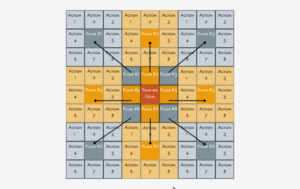
I was forwarded an article about Shohei Ohtani’s goal-setting method. I was intrigued by the chart he created as a high school freshman when he set the goal to be the number 1 Japanese draft pick. A pretty singular 14-year old already.
The Harada Method is the goal-setting system developed through trial and error by a Japanese track coach to lead his team from 380th to first place in 3 years.you can be.
The Chart
The centerpiece is a 9×9 grid called the Open Window 64. Your goal sits in the center. Eight pillars surround it, the major areas that determine whether you actually get there. Each pillar gets eight concrete actions. Sixty-four boxes total.
It’s a good tool. But also overwhelming. Thinking about doing 64 actions for one goal can be a lot. Especially as an accountability coach. I know that any goal and the subsequent actions required to get there are going to be competing for resources with an already full life.
The good news is that it’s not a to-do list, it’s a framework to hold your goal.
Before you even develop your pillars you explore wins and challenges in areas similar to your goal. So if you have a financial goal, what are some past financial wins and what did you learn from them? What are some past financial challenges and what did you learn from them? This is meant to explore the pillars that will go on to support your goal and also help you clarify why you are setting this goal and if it’s even the right goal to set. I appreciated this introspective part of the framework.
The Four Areas
Next you consider four different areas of life that can contribute to you accomplishing your goal. This will help you to come up with the 8 pillars in your chart.
The four areas are:
- Spirit – this area contributes to the why, deep motivation, belief that you can actually reach the goal
- Skills – what are the technical/professional abilities that your goal requires
- Physical condition – health, energy, the body’s capacity to sustain the effort to accomplish the goal
- Daily life – the everyday habits, environment, and systems that either support or undermine the goal
Ohtani applied these areas to his chart in interesting ways. His 8 pillars were:
- Body
- Control
- Sharpness
- Mental Toughness
- Speed 100mph
- Personality
- Karma
- Pitch Variance
Under each pillar he wrote down 8 different ways he could improve in that area. For example for mental toughness one action was to set clear goals. For Karma he wrote keep room clean. Sahil Bloom shared a nice English translation of Ohtani’s chart here.
Sixty-four boxes is not a to-do list
Once the chart is built, the second mistake is trying to treat all 64 boxes the same way, as if you’re supposed to do all of them. You’re not.
Some boxes are daily, ideally only 2-3. A few are one-time decisions you make once and never revisit. Others only happen when the moment actually calls for them.
What works: pick one to three boxes that are small enough to do no matter what kind of day you’re having. Those become your real daily habits. Everything else gets reviewed on its own natural rhythm, weekly, monthly, or as it comes up, not forced into a daily grind it was never meant to carry.
The most valuable part
I have helped people set and accomplish their goals for a long time. I think the value in the Harada method is the thinking process that it puts you through.
- What is one big goal that I’m willing to totally commit myself to?
- What is something related to your goal where you have succeeded?
- What is something related to your goal where you have failed or been disappointed?
- When I consider the different areas of my life, where do I need to put focus and energy in order to accomplish my goal?
- What are the most important 8 pillars that are going to contribute to my ability to accomplish my goal?
- What are 8 ways that I could improve in each of those 8 areas?
- When I look at the chart, what are the 2-3 things I can do to impact my goal that I’m willing to commit to doing everyday no matter what?
- Then track, update, repeat
That’s a lot to consider when setting a goal. It forces you to think expansively about everything that’s in your control in order to accomplish your goal. It also does something else very important, in order to complete your chart you not only have to think it through but you have to write it down and I never discount the power of a visual representation of a goal.
Are you intimidated or intrigued? Is this something you’d want to try?